
You are using an out of date browser. It may not display this or other websites correctly.
You should upgrade or use an alternative browser.
You should upgrade or use an alternative browser.
Multi Final Fantasy 7 Revelation
-
Thread started by cm2


In the Reveal Trailer, the party sets off across a world without boundaries. The entire planet is freely explorable via the iconic Highwind airship. Players can drop in via parachute anywhere, seamlessly transitioning from air to land. With Meteor descending and enormous Weapons unleashing terror, the planet’s conflicts are many, and the party will need to divide and conquer. Choose where to go, who to help and in what order as the planet itself fights for survival. Make one last stand alongside a beloved cast of legendary heroes, making decisions along the journey that can impact aspects of their stories. Customize combat by switching between real-time action and Tactical Mode in the series’ acclaimed hybrid battle system, now expanded and perfected with new playable characters and powerful new abilities.
-----------------------------------------------------------------------
Also game will read your save data from remake and rebirth wonder if this will change come story stuff too in revelation...
-----------------------------------------------------------------------
Also game will read your save data from remake and rebirth wonder if this will change come story stuff too in revelation...

Hamaguchi just said more stuff:
-Player choice will have consequences unlike Rebirth, and this will affect the storytelling of the game. Each player might end up with a completely different experience
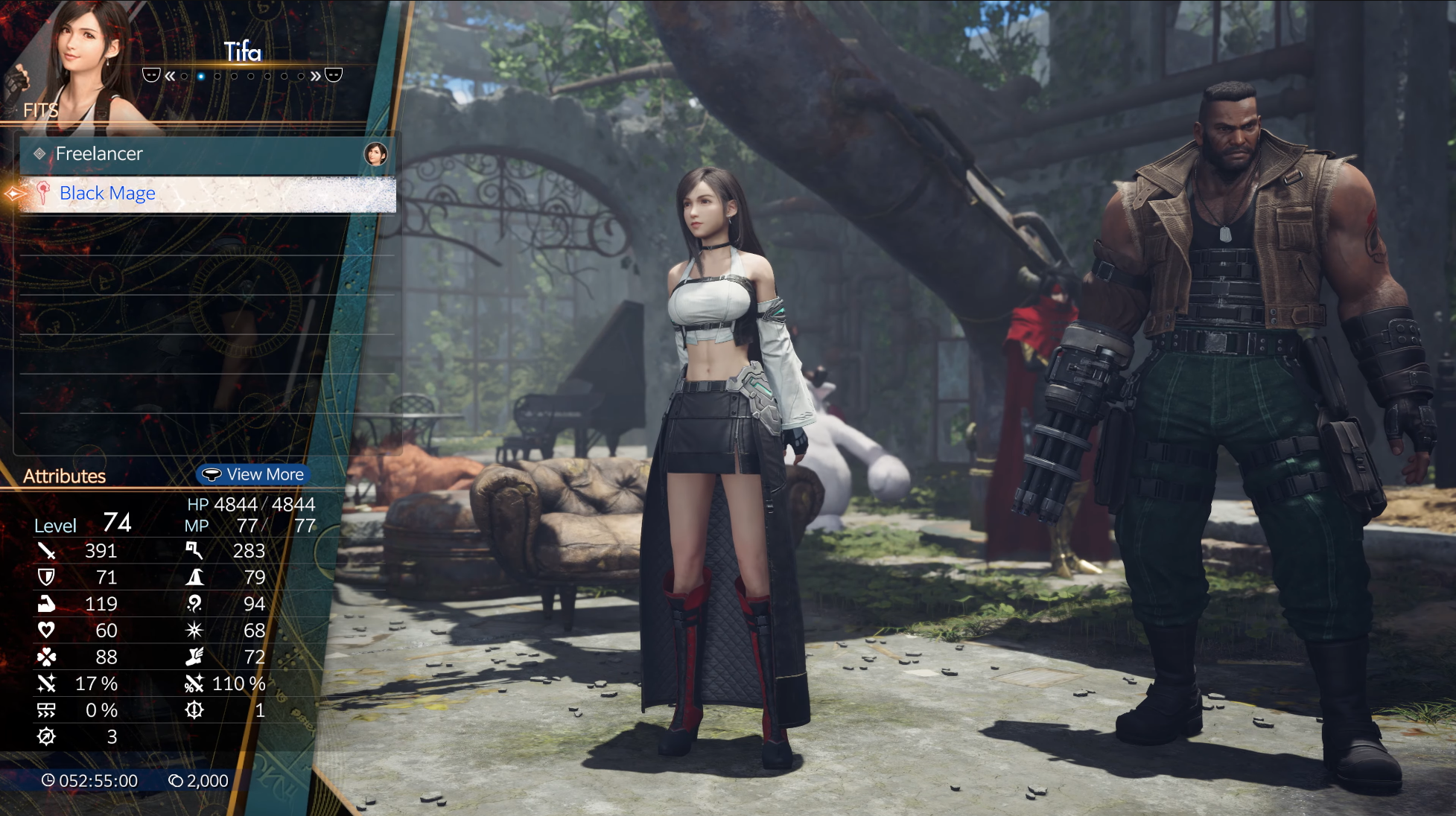
.-The Highwind airship will be available from the beginning of the game-The wear system (jobs) will also be unlocked early on in the game.-New stories will be told regarding places not explored much in the OG
-There are a lot of areas you can access with the Highwind early on, but you might not be able to proceed since enemeries are incredibly strong. They want players to have the feeling of "what should I do first?"
-The scale of the 'open world' feel of the game has greatly expanded-
Vincent gameplay allows him to switch between human form and beast mode with one button. There is no time limit, similar to how Yuffie uses her shuriken mode.
-Cid is very adept at aerial combat
-Vincent and Cid have synergy elements as well as with other characters too.
-Zack will have even more scenes in Part 3 and plays an important role
-The replacement VA for Reno has been decided, and Reno and the Turks will have a lot of screentime in this game
-Wutai is incredibly fleshed out this time around, and the Turks will also be a part of it. Wutai will have a very political storyline involved.-Midgar is back in Part 3 and you can explore it again, and you may even encounter some Deepground characters as well...
-Rocket Town is indeed in the game. Hamaguchi says they actually wanted it to show up in Rebirth, but they decided to have it in Revelation instead. It will be accessible towards the latter part of the story
-The underwater area will appear in Revelation, but he can't delve into details just yet
-Hamaguchi says that OG FF7's Knights of the Round summon was something that came up in discussions in every part of the FF7 Remake series. They are currently developing the content to be worthy of its epicness, so he tells fans to look forward to seeing how it will be shown in the game
-FF7 Revelation does indeed have an ending, and it is one that Hamaguchi is proud of that serves as a conclusion to a series that has taken more than ten years. As for what that ending will be, you'll just have to experience it yourself.
-The affinity system from Rebirth will be different in Revelation. More focus will be put to some extent for all characters to flesh them out properly.
-If you want to learn more about a certain character, you will be able to do so in a way that will deliver a different experience than the one in Rebirth.
-Hamaguchi doesn't really like the concept of multiple endings and as a creator wants to deliver a confident ending to the FF7 Remake series; HOWEVER, player choice in Revelation will heavily affect what outcome you get that actually changes the storytelling of the game
.-Mini games will not be less in number, but they are toning down the difficulty for players who had issues with them in Rebirth
-The slap fight between Scarlet and Tifa is indeed still in the game and will be a mini game lol
-The theme of FF7 Revelation is "resolve." Everyone has followed the journey of Cloud and his friends for almost a decade at this point, and the story is filled with determination as it heads to its finale. The development team has put their resolves into delivering something truly great for everyone to enjoy.
-Player choice will have consequences unlike Rebirth, and this will affect the storytelling of the game. Each player might end up with a completely different experience
.-The Highwind airship will be available from the beginning of the game-The wear system (jobs) will also be unlocked early on in the game.-New stories will be told regarding places not explored much in the OG
-There are a lot of areas you can access with the Highwind early on, but you might not be able to proceed since enemeries are incredibly strong. They want players to have the feeling of "what should I do first?"
-The scale of the 'open world' feel of the game has greatly expanded-
Vincent gameplay allows him to switch between human form and beast mode with one button. There is no time limit, similar to how Yuffie uses her shuriken mode.
-Cid is very adept at aerial combat
-Vincent and Cid have synergy elements as well as with other characters too.
-Zack will have even more scenes in Part 3 and plays an important role
-The replacement VA for Reno has been decided, and Reno and the Turks will have a lot of screentime in this game
-Wutai is incredibly fleshed out this time around, and the Turks will also be a part of it. Wutai will have a very political storyline involved.-Midgar is back in Part 3 and you can explore it again, and you may even encounter some Deepground characters as well...
-Rocket Town is indeed in the game. Hamaguchi says they actually wanted it to show up in Rebirth, but they decided to have it in Revelation instead. It will be accessible towards the latter part of the story
-The underwater area will appear in Revelation, but he can't delve into details just yet
-Hamaguchi says that OG FF7's Knights of the Round summon was something that came up in discussions in every part of the FF7 Remake series. They are currently developing the content to be worthy of its epicness, so he tells fans to look forward to seeing how it will be shown in the game
-FF7 Revelation does indeed have an ending, and it is one that Hamaguchi is proud of that serves as a conclusion to a series that has taken more than ten years. As for what that ending will be, you'll just have to experience it yourself.
-The affinity system from Rebirth will be different in Revelation. More focus will be put to some extent for all characters to flesh them out properly.
-If you want to learn more about a certain character, you will be able to do so in a way that will deliver a different experience than the one in Rebirth.
-Hamaguchi doesn't really like the concept of multiple endings and as a creator wants to deliver a confident ending to the FF7 Remake series; HOWEVER, player choice in Revelation will heavily affect what outcome you get that actually changes the storytelling of the game
.-Mini games will not be less in number, but they are toning down the difficulty for players who had issues with them in Rebirth
-The slap fight between Scarlet and Tifa is indeed still in the game and will be a mini game lol
-The theme of FF7 Revelation is "resolve." Everyone has followed the journey of Cloud and his friends for almost a decade at this point, and the story is filled with determination as it heads to its finale. The development team has put their resolves into delivering something truly great for everyone to enjoy.
Last edited:
Automaton media Hamaguchi interview:
Naoki Hamaguchi (hereafter, Hamaguchi):
It’s not exactly a challenge, but throughout this remake trilogy, we’ve always wanted the gameplay experience to transform with each new entry, so when it came to FFVII Rebirth and FFVII Revelation, the first thing we discussed as a team was how and what to change.
Every game in this series is developed by a large team, so it’s important to establish a clear theme that defines what the game is about. For FFVII Rebirth, that theme was “bonds,” and for this new title, we’ve chosen “resolve” as the central theme.
Simply put, from the story’s perspective, Cloud and the others face their final battle, where they’ll confront the feelings and burdens they’ve carried with them, and they are filled with resolve to face those things head-on. As creators, we also have the resolve to properly bring this trilogy to its conclusion. When we translated that idea into game design, we felt that players themselves should also be asked to make their own choices with conviction.
For example, in FFVII Rebirth, the world map was packed with content, and no matter what order players tackled it in, there were no disadvantages. You could simply start playing from whatever interested you first, and eventually you’d clear everything. We designed it to give players a sense of security.
—True, it felt a bit like popping bubble wrap.
Hamaguchi:
Exactly (laughs). But I don’t think that was a bad thing in itself. In fact, I think it worked really well for FFVII Rebirth. However, when developing FFVII Revelation, we wanted to change things, so this time, we’re asking players to make more choices of their own. We’ve included far more sections in this game where players’ choices are so crucial that they can alter not only how they progress through the game, but even the direction of the storytelling itself. In that sense, players will need to make decisions under a certain amount of tension, and I think that’s one of the biggest differences from FFVII Rebirth. This is a game where your experience changes based on your choices, yet things ultimately converge toward a single conclusion.
FFVII is a series where fans feel strong affection towards the characters, so we’re aiming for an experience where the player’s actions determine what they’ll see more deeply through the characters.
—So you’re portraying the consequences of each choice in a way that feels true to the world and tone of FFVII.
Hamaguchi:
I believe the key question for FFVII Revelation is how deeply we can explore the characters, and having that exploration change depending on the player’s choices felt like the right approach for this game. In the previous title, players might have experienced content in a different order, but ultimately, everyone saw almost the same things. This time, we wanted to create experiences that could completely differ from one player to another.
There’s also something I think both players and the media are probably curious about: which game has more content, FFVII Rebirth or FFVII Revelation?
—I’m definitely curious about that.
Hamaguchi:
In terms of volume, I’d say they’re roughly the same, or perhaps FFVII Revelation may be a bit larger. Since each player’s experience differs, it’s impossible to see everything in a single playthrough. When you consider the total volume of all possible experiences combined, it’s honestly hard to say whether FFVII Rebirth or FFVII Revelation contains more content, that’s how substantial FFVII Revelation is.
—I noticed the trailer says something along the lines of, “How you play is up to you,” suggesting a higherf degree of freedom in gameplay. What kind of freedom are we talking about?
Hamaguchi:
Fundamentally, player involvement in the game (the choices we discussed earlier), can directly affect both gameplay progression and storytelling to the point of the narrative branching… Though, if I put it that way, it might end up coming off as a multi-ending game (laughs).
I want to be very clear about the ending. Numerous fans have stayed with us throughout this trilogy, and we intend to provide a definitive conclusion as our answer to them. In that sense, nothing has changed – there is only one ending. The overall direction of the story does not change, so everyone can rest assured about that. However, the choices players make on the journey toward that conclusion will affect their individual experiences, as well as the stories told through side content.
—Meaning, even if it’s not a multi-ending game, it’s fair to expect a meaningful amount of branching within the story itself?
Hamaguchi:
Yes. However, since FFVII has a very large fanbase that loves the main story, rather than cramming branches into the main narrative itself, we’ve focused on enriching the main story through side content in a variety of ways, while incorporating branching paths that allow players to tailor their experience.
Hamaguchi:
One thing we’ve done is to make the rewards system much clearer. In FFVII Revelation’s side content, we’ve made it immediately obvious what you’ll get from participating. Players can quickly understand, “If you want this reward, this is the activity you should do.” For example, you’ll know if an activity awards Materia, items to buff your characters, or something unrelated to battle, like character skins. Looking at modern games, we considered which format would be most enjoyable for users, and felt that making rewards more direct would better motivate them.
—On that topic, FFVII Rebirth also received a lot of complaints regarding its minigames. How have you addressed that?
Hamaguchi:
The request to reduce the number of minigames is a difficult one. I have a very clear policy that I don’t want to change, no matter how much feedback we receive. After all, the original FFVII had an enormous number of minigames. This remake series exists because of the original game, and respecting the original is one of our core policies.
More than in previous installments, we’ve made it so that you don’t have to engage with minigames if you don’t want to. For example, when it comes to minigames tied to battle progression, players who wanted to focus on combat ended up feeling forced to play them. To address that, minigame rewards are now largely unrelated to combat progression. Instead, they offer things like character skins and customization options, so that only those who want to play them are encouraged to do so. Meanwhile, battle progression and the like are tied more closely to combat-oriented side content. Overall, I think the game is much more comfortable to play than past entries.
That said, I imagine there will always be players who dislike a particular minigame but still want its rewards. To help with that, we’ve added difficulty settings specifically for minigames. So now you can lower the difficulty to “Easy” if you wish, and if you try a minigame and immediately decide it’s a lost cause, you can also skip it right away. We’ve made a number of improvements aimed at minimizing frustration.
In that sense, we’ve done everything we reasonably can. We won’t reduce the number of minigames, but we will continue making every effort to ensure as many players as possible can embrace them.
—So rather than reducing minigames, you’ve placed greater emphasis on “you don’t have to do them if you don’t want to.” Why was it important not to cut back on minigames?
Hamaguchi:
The abundance of minigames is one of the original game’s defining traits, so even in a remake, that’s not something I intend to change. On the other hand, I do believe it’s crucial to make them more comfortable to play and to ensure players don’t feel disadvantaged if they choose to skip them. We’ve incorporated the lessons we learned from FFVII Rebirth into this game, so I’m looking forward to seeing how players respond to it.
―When it comes to long playing sessions, including minigames, it’s important to know upfront what you’ll get out of it. Even when you’re having fun, I think it’s common, especially with big-budget titles, to find yourself wondering, “Wait, what was I doing all this for again?”
Hamaguchi:
Especially in this game, you obtain the Highwind fairly early on, and from that point you’re essentially told, “Go wherever you want and play however you like.” In FFVII Rebirth, many players would clear one area at a time and wouldn’t move on to the next until they’d fully completed that area.
—I was like that too.
Hamaguchi:
In FFVII Revelation, because the world opens up so much, you’ll have access to a wide range of areas with very different difficulty levels. You might wander into a place out of curiosity and immediately get demolished by powerful enemies, so you’ll also be moving back and forth between regions much more frequently. When that happens, I think players are even more likely than before to find themselves asking, “What was I supposed to be doing again?”
When it comes to the purpose behind each piece of content in a game, the narrative experience is something that follows afterward, but the most immediate factor is the reward you’re going to receive. We felt that communicating those rewards more clearly would better suit the game’s design, so we made major changes in that area.
—I assume that if the only reward for a lengthy quest is story-related, then for people who don’t particularly value narrative, it can feel like a chore. I understand the rewards are now more closely tied to gameplay systems?
Hamaguchi:
That’s right. The world of FFVII contains a huge variety of content, and naturally there are bound to be things that simply don’t appeal to certain players. What’s important is for players to feel that they don’t have to do things they don’t like, and I felt the previous game was a bit too strict in that regard. We’re addressing that as a point of reflection.
—Beyond that, are there any other measures you’ve taken to make the game enjoyable over extended play sessions?
Hamaguchi:
I’m not sure whether this is the correct answer, but in this game, the world map is divided into numerous regions, and obtaining the Highwind allows you to travel to many different places.
However, there are still locations you can’t access because of story-related reasons. For example, the Nort Crater becomes inaccessible for a period of time because a Weapon has appeared there. There are several areas that are effectively off-limits because they’re considered too dangerous within the story. As a result, when you eventually gain access to those places later on, I think players will enjoy the sense of freshness that comes from discovering entirely new types of content.
Another factor is the growth of Pico, your Chocobo. At first, Pico can do little more than run across the ground, but eventually, it develops to the point where it can fly and glide across any area. Because of that, I think revisiting the same area later in the game can feel very different from your first visit. As a creator, I’ve really come to appreciate how important spatial exploration is to an open-world game.
—In FFVII Rebirth, you already ventured into vertical exploration to some extent.
Hamaguchi:
Yes, it was only partially present in FFVII Rebirth. After all, once you try to make that kind of design work consistently across every region, all sorts of problems emerge. We’re still dealing with some of those issues even now.
Another difference is that in FFVII Rebirth, most quests were largely self-contained within a single area. In FFVII Revelation, content difficulty and variety are no longer limited to individual regions. For example, you might pick up a quest in one location, then have to travel to another area to progress it, and then continue on to a third – some quests will have you flying all over the world before they’re completed.
If you’ve already visited an area, you can use fast travel to reach it. If you haven’t, you can fly there using the Highwind and even parachute directly onto your destination from the sky. That’s another major difference from the previous game.
—Even though the main story deals with a serious situation, there’s often a contrast in RPGs where side content remains relatively lighthearted. I find that can sometimes feel jarring, especially in story-driven games. What are your thoughts on that?
Hamaguchi:
Actually, that’s something I’d like to hear players’ final thoughts on after they’ve experienced the game. Because the story is so important to this title, we’ve paid close attention to it, and between major story developments, we’ve tried to create moments where players naturally feel, “Okay, now’s a good time to go do some side content.”
I believe we’ve achieved reasonable balance between the tone of the main story and the tone of the side quests.
Hamaguchi:
Well, that would have to be the fact that it concludes the story. People often ask us, “Will it really end this time?,” but this game’s very purpose is to bring the story to a conclusion.
I’ll continue telling everyone this as much as I can, but one of this game’s greatest strengths is that we are absolutely going to finish it.
For those who have stayed with us through the first and second games, I think that alone will be gratifying. There are also many fans of the original FFVII who love the game but have been reluctant to start the remake trilogy until all the installments were available. For those people as well, the message is finally simple and clear: it’s finally coming to its conclusion. That, too, is part of our genuine “resolve,” to see this through to the end.
—I imagine development is still ongoing, but could you tell us about the team’s current state and what mindset you’re carrying as you work on the game?
Hamaguchi:
Currently, we’re playing through the game every day, making adjustments where things feel rough around the edges, and adding assets that weren’t fully implemented yet. We’re in the final polishing stage, repeating this process while addressing any bugs that arise along the way.
—It’s been more than two years since FFVII Rebirth launched, but it sounds like FFVII Revelation will arrive quite quickly compared to the gap between FFVII Remake and FFVII Rebirth.
Hamaguchi:
That’s true.
—It must have been quite hectic.
Hamaguchi:
It’s been incredibly tough (laughs). But we believe that releasing this game into the world as quickly as possible is one of the most important things not just for us, but for the fans as well.
The entire team is pouring everything we have into finishing it, so please look forward to it.
—Thank you very much for your time. I’m looking forward to the release.
The themes of the trilogy’s finale are “Resolve” and “Choice”
—Following from Final Fantasy VII Rebirth, what were the biggest challenges you faced while developing Final Fantasy VII Revelation?Naoki Hamaguchi (hereafter, Hamaguchi):
It’s not exactly a challenge, but throughout this remake trilogy, we’ve always wanted the gameplay experience to transform with each new entry, so when it came to FFVII Rebirth and FFVII Revelation, the first thing we discussed as a team was how and what to change.
Every game in this series is developed by a large team, so it’s important to establish a clear theme that defines what the game is about. For FFVII Rebirth, that theme was “bonds,” and for this new title, we’ve chosen “resolve” as the central theme.
Simply put, from the story’s perspective, Cloud and the others face their final battle, where they’ll confront the feelings and burdens they’ve carried with them, and they are filled with resolve to face those things head-on. As creators, we also have the resolve to properly bring this trilogy to its conclusion. When we translated that idea into game design, we felt that players themselves should also be asked to make their own choices with conviction.
For example, in FFVII Rebirth, the world map was packed with content, and no matter what order players tackled it in, there were no disadvantages. You could simply start playing from whatever interested you first, and eventually you’d clear everything. We designed it to give players a sense of security.
—True, it felt a bit like popping bubble wrap.
Hamaguchi:
Exactly (laughs). But I don’t think that was a bad thing in itself. In fact, I think it worked really well for FFVII Rebirth. However, when developing FFVII Revelation, we wanted to change things, so this time, we’re asking players to make more choices of their own. We’ve included far more sections in this game where players’ choices are so crucial that they can alter not only how they progress through the game, but even the direction of the storytelling itself. In that sense, players will need to make decisions under a certain amount of tension, and I think that’s one of the biggest differences from FFVII Rebirth. This is a game where your experience changes based on your choices, yet things ultimately converge toward a single conclusion.
FFVII is a series where fans feel strong affection towards the characters, so we’re aiming for an experience where the player’s actions determine what they’ll see more deeply through the characters.
—So you’re portraying the consequences of each choice in a way that feels true to the world and tone of FFVII.
Hamaguchi:
I believe the key question for FFVII Revelation is how deeply we can explore the characters, and having that exploration change depending on the player’s choices felt like the right approach for this game. In the previous title, players might have experienced content in a different order, but ultimately, everyone saw almost the same things. This time, we wanted to create experiences that could completely differ from one player to another.
There’s also something I think both players and the media are probably curious about: which game has more content, FFVII Rebirth or FFVII Revelation?
—I’m definitely curious about that.
Hamaguchi:
In terms of volume, I’d say they’re roughly the same, or perhaps FFVII Revelation may be a bit larger. Since each player’s experience differs, it’s impossible to see everything in a single playthrough. When you consider the total volume of all possible experiences combined, it’s honestly hard to say whether FFVII Rebirth or FFVII Revelation contains more content, that’s how substantial FFVII Revelation is.
—I noticed the trailer says something along the lines of, “How you play is up to you,” suggesting a higher
Hamaguchi:
Fundamentally, player involvement in the game (the choices we discussed earlier), can directly affect both gameplay progression and storytelling to the point of the narrative branching… Though, if I put it that way, it might end up coming off as a multi-ending game (laughs).
I want to be very clear about the ending. Numerous fans have stayed with us throughout this trilogy, and we intend to provide a definitive conclusion as our answer to them. In that sense, nothing has changed – there is only one ending. The overall direction of the story does not change, so everyone can rest assured about that. However, the choices players make on the journey toward that conclusion will affect their individual experiences, as well as the stories told through side content.
—Meaning, even if it’s not a multi-ending game, it’s fair to expect a meaningful amount of branching within the story itself?
Hamaguchi:
Yes. However, since FFVII has a very large fanbase that loves the main story, rather than cramming branches into the main narrative itself, we’ve focused on enriching the main story through side content in a variety of ways, while incorporating branching paths that allow players to tailor their experience.
Addressing the minigame issue
—Personally, I enjoyed exploring in FFVII Rebirth because there were so many quests and collectibles, but there were also moments where the pacing started to drag during longer gaming sessions. Have you refined the gameplay loop to make players more eager to move on to the next objective?Hamaguchi:
One thing we’ve done is to make the rewards system much clearer. In FFVII Revelation’s side content, we’ve made it immediately obvious what you’ll get from participating. Players can quickly understand, “If you want this reward, this is the activity you should do.” For example, you’ll know if an activity awards Materia, items to buff your characters, or something unrelated to battle, like character skins. Looking at modern games, we considered which format would be most enjoyable for users, and felt that making rewards more direct would better motivate them.
—On that topic, FFVII Rebirth also received a lot of complaints regarding its minigames. How have you addressed that?
Hamaguchi:
The request to reduce the number of minigames is a difficult one. I have a very clear policy that I don’t want to change, no matter how much feedback we receive. After all, the original FFVII had an enormous number of minigames. This remake series exists because of the original game, and respecting the original is one of our core policies.
More than in previous installments, we’ve made it so that you don’t have to engage with minigames if you don’t want to. For example, when it comes to minigames tied to battle progression, players who wanted to focus on combat ended up feeling forced to play them. To address that, minigame rewards are now largely unrelated to combat progression. Instead, they offer things like character skins and customization options, so that only those who want to play them are encouraged to do so. Meanwhile, battle progression and the like are tied more closely to combat-oriented side content. Overall, I think the game is much more comfortable to play than past entries.
That said, I imagine there will always be players who dislike a particular minigame but still want its rewards. To help with that, we’ve added difficulty settings specifically for minigames. So now you can lower the difficulty to “Easy” if you wish, and if you try a minigame and immediately decide it’s a lost cause, you can also skip it right away. We’ve made a number of improvements aimed at minimizing frustration.
In that sense, we’ve done everything we reasonably can. We won’t reduce the number of minigames, but we will continue making every effort to ensure as many players as possible can embrace them.
—So rather than reducing minigames, you’ve placed greater emphasis on “you don’t have to do them if you don’t want to.” Why was it important not to cut back on minigames?
Hamaguchi:
The abundance of minigames is one of the original game’s defining traits, so even in a remake, that’s not something I intend to change. On the other hand, I do believe it’s crucial to make them more comfortable to play and to ensure players don’t feel disadvantaged if they choose to skip them. We’ve incorporated the lessons we learned from FFVII Rebirth into this game, so I’m looking forward to seeing how players respond to it.
―When it comes to long playing sessions, including minigames, it’s important to know upfront what you’ll get out of it. Even when you’re having fun, I think it’s common, especially with big-budget titles, to find yourself wondering, “Wait, what was I doing all this for again?”
Hamaguchi:
Especially in this game, you obtain the Highwind fairly early on, and from that point you’re essentially told, “Go wherever you want and play however you like.” In FFVII Rebirth, many players would clear one area at a time and wouldn’t move on to the next until they’d fully completed that area.
—I was like that too.
Hamaguchi:
In FFVII Revelation, because the world opens up so much, you’ll have access to a wide range of areas with very different difficulty levels. You might wander into a place out of curiosity and immediately get demolished by powerful enemies, so you’ll also be moving back and forth between regions much more frequently. When that happens, I think players are even more likely than before to find themselves asking, “What was I supposed to be doing again?”
When it comes to the purpose behind each piece of content in a game, the narrative experience is something that follows afterward, but the most immediate factor is the reward you’re going to receive. We felt that communicating those rewards more clearly would better suit the game’s design, so we made major changes in that area.
—I assume that if the only reward for a lengthy quest is story-related, then for people who don’t particularly value narrative, it can feel like a chore. I understand the rewards are now more closely tied to gameplay systems?
Hamaguchi:
That’s right. The world of FFVII contains a huge variety of content, and naturally there are bound to be things that simply don’t appeal to certain players. What’s important is for players to feel that they don’t have to do things they don’t like, and I felt the previous game was a bit too strict in that regard. We’re addressing that as a point of reflection.
—Beyond that, are there any other measures you’ve taken to make the game enjoyable over extended play sessions?
Hamaguchi:
I’m not sure whether this is the correct answer, but in this game, the world map is divided into numerous regions, and obtaining the Highwind allows you to travel to many different places.
However, there are still locations you can’t access because of story-related reasons. For example, the Nort Crater becomes inaccessible for a period of time because a Weapon has appeared there. There are several areas that are effectively off-limits because they’re considered too dangerous within the story. As a result, when you eventually gain access to those places later on, I think players will enjoy the sense of freshness that comes from discovering entirely new types of content.
Another factor is the growth of Pico, your Chocobo. At first, Pico can do little more than run across the ground, but eventually, it develops to the point where it can fly and glide across any area. Because of that, I think revisiting the same area later in the game can feel very different from your first visit. As a creator, I’ve really come to appreciate how important spatial exploration is to an open-world game.
—In FFVII Rebirth, you already ventured into vertical exploration to some extent.
Hamaguchi:
Yes, it was only partially present in FFVII Rebirth. After all, once you try to make that kind of design work consistently across every region, all sorts of problems emerge. We’re still dealing with some of those issues even now.
Another difference is that in FFVII Rebirth, most quests were largely self-contained within a single area. In FFVII Revelation, content difficulty and variety are no longer limited to individual regions. For example, you might pick up a quest in one location, then have to travel to another area to progress it, and then continue on to a third – some quests will have you flying all over the world before they’re completed.
If you’ve already visited an area, you can use fast travel to reach it. If you haven’t, you can fly there using the Highwind and even parachute directly onto your destination from the sky. That’s another major difference from the previous game.
—Even though the main story deals with a serious situation, there’s often a contrast in RPGs where side content remains relatively lighthearted. I find that can sometimes feel jarring, especially in story-driven games. What are your thoughts on that?
Hamaguchi:
Actually, that’s something I’d like to hear players’ final thoughts on after they’ve experienced the game. Because the story is so important to this title, we’ve paid close attention to it, and between major story developments, we’ve tried to create moments where players naturally feel, “Okay, now’s a good time to go do some side content.”
I believe we’ve achieved reasonable balance between the tone of the main story and the tone of the side quests.
FFVII Revelation will truly bring the trilogy to a close
— FFVII Remake had the clear appeal of reimagining FFVII itself, while FFVII Rebirth offered the continuation of the story and the excitement of finally leaving Midgar behind. What would you say is FFVII Revelation’s defining strength?Hamaguchi:
Well, that would have to be the fact that it concludes the story. People often ask us, “Will it really end this time?,” but this game’s very purpose is to bring the story to a conclusion.
I’ll continue telling everyone this as much as I can, but one of this game’s greatest strengths is that we are absolutely going to finish it.
For those who have stayed with us through the first and second games, I think that alone will be gratifying. There are also many fans of the original FFVII who love the game but have been reluctant to start the remake trilogy until all the installments were available. For those people as well, the message is finally simple and clear: it’s finally coming to its conclusion. That, too, is part of our genuine “resolve,” to see this through to the end.
—I imagine development is still ongoing, but could you tell us about the team’s current state and what mindset you’re carrying as you work on the game?
Hamaguchi:
Currently, we’re playing through the game every day, making adjustments where things feel rough around the edges, and adding assets that weren’t fully implemented yet. We’re in the final polishing stage, repeating this process while addressing any bugs that arise along the way.
—It’s been more than two years since FFVII Rebirth launched, but it sounds like FFVII Revelation will arrive quite quickly compared to the gap between FFVII Remake and FFVII Rebirth.
Hamaguchi:
That’s true.
—It must have been quite hectic.
Hamaguchi:
It’s been incredibly tough (laughs). But we believe that releasing this game into the world as quickly as possible is one of the most important things not just for us, but for the fans as well.
The entire team is pouring everything we have into finishing it, so please look forward to it.
—Thank you very much for your time. I’m looking forward to the release.

- Credits
- 157,964


Trailer looks really great, I hope they go into AC and DoC after this.